Choose a coloring page by its structure, not just its subject
A butterfly may look more approachable than a geometric mandala, but the picture's subject does not tell you how small its coloring spaces are. Look at where the outlines divide the page, which decisions repeat and where you could stop. Those clues help you choose a page that suits the kind of coloring you want to do.
Here are three actual pages from our Intricate Patterns corrected selection. All are detailed. The differences below describe their visible structure, not measured difficulty scores or promised completion times.
Butterfly: choose one wing panel
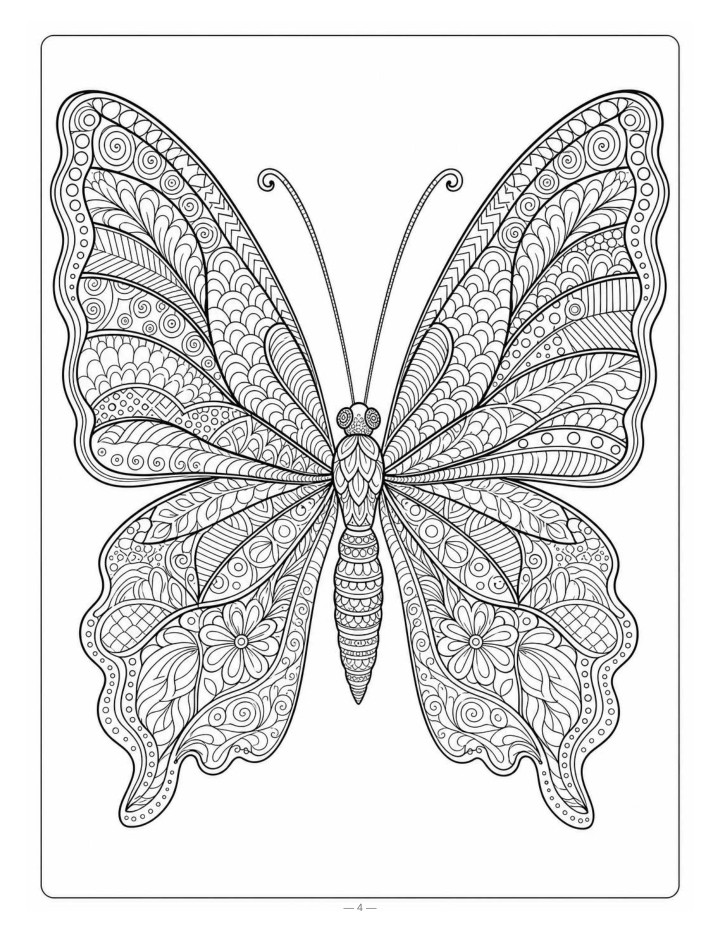
PDF page 6. Digital preview, not a physical print.
The butterfly has a clearly defined outer silhouette, white space around it and several patterned panels inside each wing. You can point to one panel and make it your whole assignment. You do not need to fill the background to make that section feel deliberate.
Look at the upper wings before choosing a pencil. Some panels contain repeated curls, circles or narrow lines. Decide whether you want to color each tiny enclosed space or carry one color across a larger outlined panel while allowing the black pattern to remain visible. Either choice gives you a different amount of detail to manage.
If you enjoy paired decisions, echo a color on the opposite wing. The printed patterns are not perfectly identical, so match the broad placement rather than forcing every small mark to have a twin.
Feather: follow one section beside the shaft
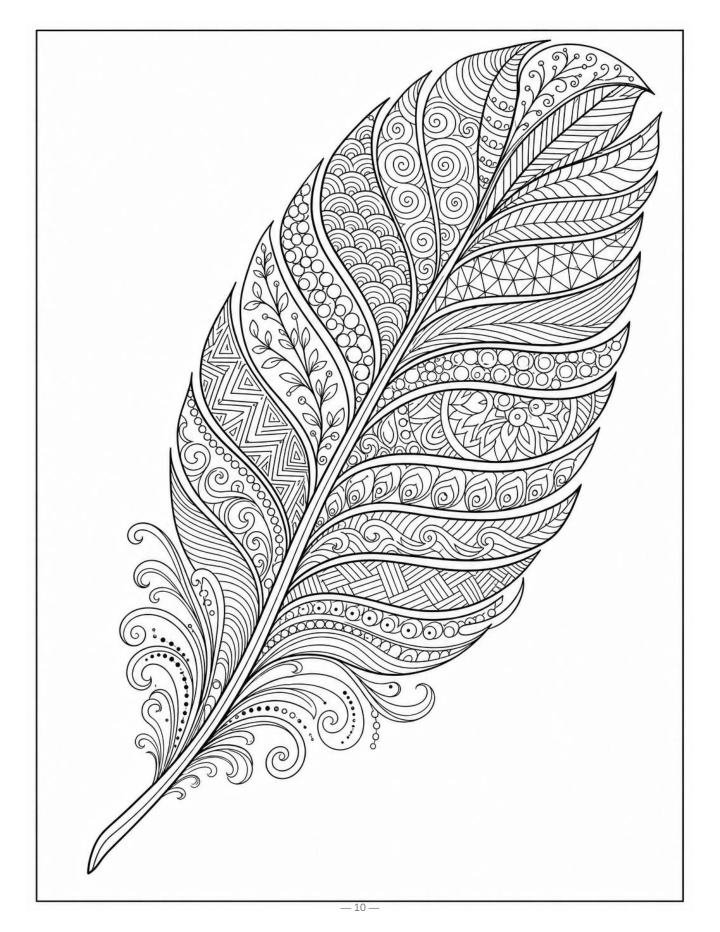
PDF page 12. Digital preview, not a physical print.
The central shaft gives the feather a clear direction. Patterned sections branch away from it, with noticeable changes between curls, circles, leaf shapes and narrow strokes. Choose one section whose outlines you can follow easily; you can leave its neighbors for another session.
This layout is useful when you prefer variety over repeating the same petal around a circle. It also lets you change the color rule at a visible boundary. For example, use one color in a broad section, then a second color in the adjacent narrow section. Check a single small area first: some of the decorative spaces are much tighter than the feather's overall shape suggests.
Mandala: repeat a decision around the center
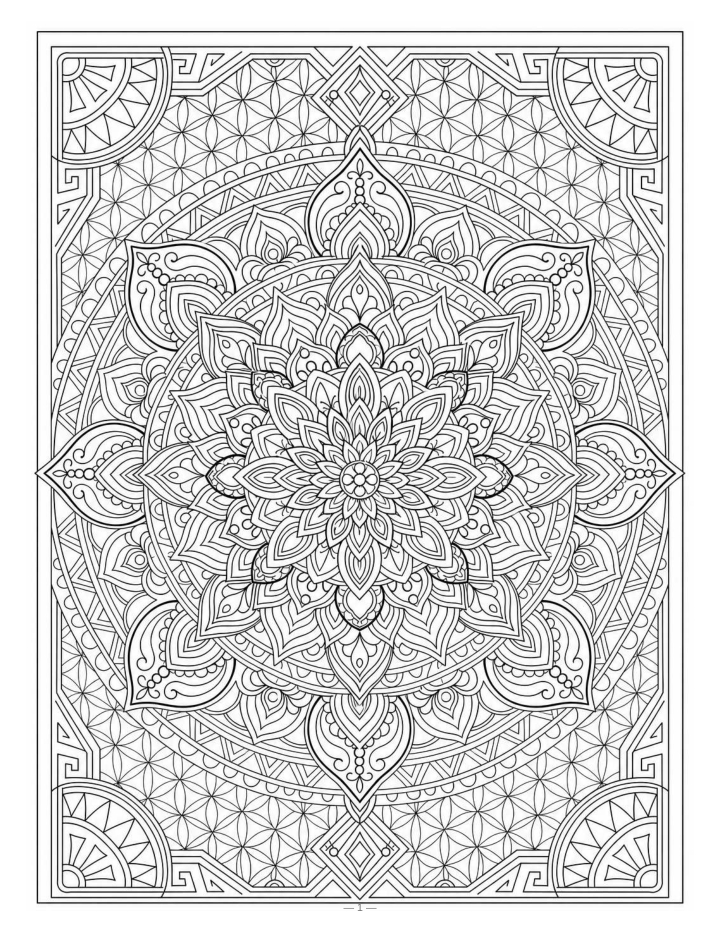
PDF page 3. Digital preview, not a physical print.
The mandala offers repetition. Once you choose how to color one petal, you can carry that decision around a group. This can reduce the number of new color choices even though the drawing itself is intricate.
The tradeoff is density. Its outer border and overlapping pointed shapes contain many small spaces. Begin at the little center flower and one surrounding group, then stop before planning the edge. Our three-pencil guide walks through that smaller assignment.
Pick the decision you want to make
| If you want to… | Try… | Start with… |
|---|---|---|
| Color a recognizable subject in separate areas | Butterfly, PDF page 6 | One upper-wing panel |
| Move through changing textures | Feather, PDF page 12 | One section beside the shaft |
| Repeat a small set of color choices | Mandala, PDF page 3 | The center and one petal group |
Before committing to the whole page, point to your stopping boundary. If you cannot see one, choose a smaller section. You can also leave tiny spaces white; every enclosure does not need its own color.
Use a single-page print check to see whether the detail is comfortable at your chosen print size. The website images are previews, so print from the purchased PDF instead.
About these examples
We make and sell the Intricate Patterns PDF on Etsy. The corrected selection contains 26 designs in 30 PDF pages. These three previews reproduce its actual pages without adding or completing artwork. The collection uses AI-assisted art and is for personal use; no physical book or coloring supplies are included.